
Start with STRUCTURE assessment or a meeting with us
Complete the STRUCTURE assessment to identify your organization’s needs, or contact us to schedule an introductory meeting.

Programs
We offer organizational designs, tailored and industry-specialized programs (E-Programs), developed within our CO-E Change framework. Delivered fully online, they allow organizations to engage with development processes at their own pace and in their own context.
Our STRUCTURE assessment acts as a starting point, an online reflective entry designed for management to explore perspectives on communication and collaboration. The assessment creates a foundation for focused dialogue and measurable results.
Grounded in a circular and relational approach we combine process design with interactive tools to ensure that each program is closely aligned with your organization's specific context and needs.
What we offer
We collaborate closely with your teams, whether in specific departments or across the entire organization, always aligning with your company's structural framework. Your organization sets the direction, and we support employees in following it effectively.
Through our needs assessments that measure relational skills, management gains a clear understanding of team dynamics and development needs. Our Organizational Design program is the only Program that fully addresses the complexity of co-e Change, helping your organization thrive in a rapidly evolving business landscape.

Our customized programs feature the Phase Structure – Leadership modules within the co-e Change framework, giving management a clear overview of relational skills — both individually and across teams.
Using targeted assessments, we design a program tailored specifically to your organization's needs, ensuring practical and impactful results.
What we offer
Strengthening partnerships and communication across cultures is at the core of this program.
Built on the principles of the co-e Change framework, the program provides organizations with a strategic foundation for developing impactful digital initiatives, enhancing leadership communication, and building sustainable partner relations.
Through tailored client meetings, legitimacy analysis, and strategic communication development, we work closely with your organization to strengthen credibility, improve stakeholder engagement, and create meaningful connections with new partners and markets.
The program is designed to deliver measurable progress and long-term impact through assessments, actionable insights, and strategic implementation.
Program Features
How CO-E Programs work
Complete the STRUCTURE assessment to identify your organization’s needs, or contact us to schedule an introductory meeting.
Together we clarify your challenges, goals, expectations, and the scope of the program.
Your customized CO-E Program is prepared and made available through the CO-E Platform.
The program is initiated in alignment with the agreed plan, with ongoing dialogue, evaluation, and adjustment throughout the process.
The method
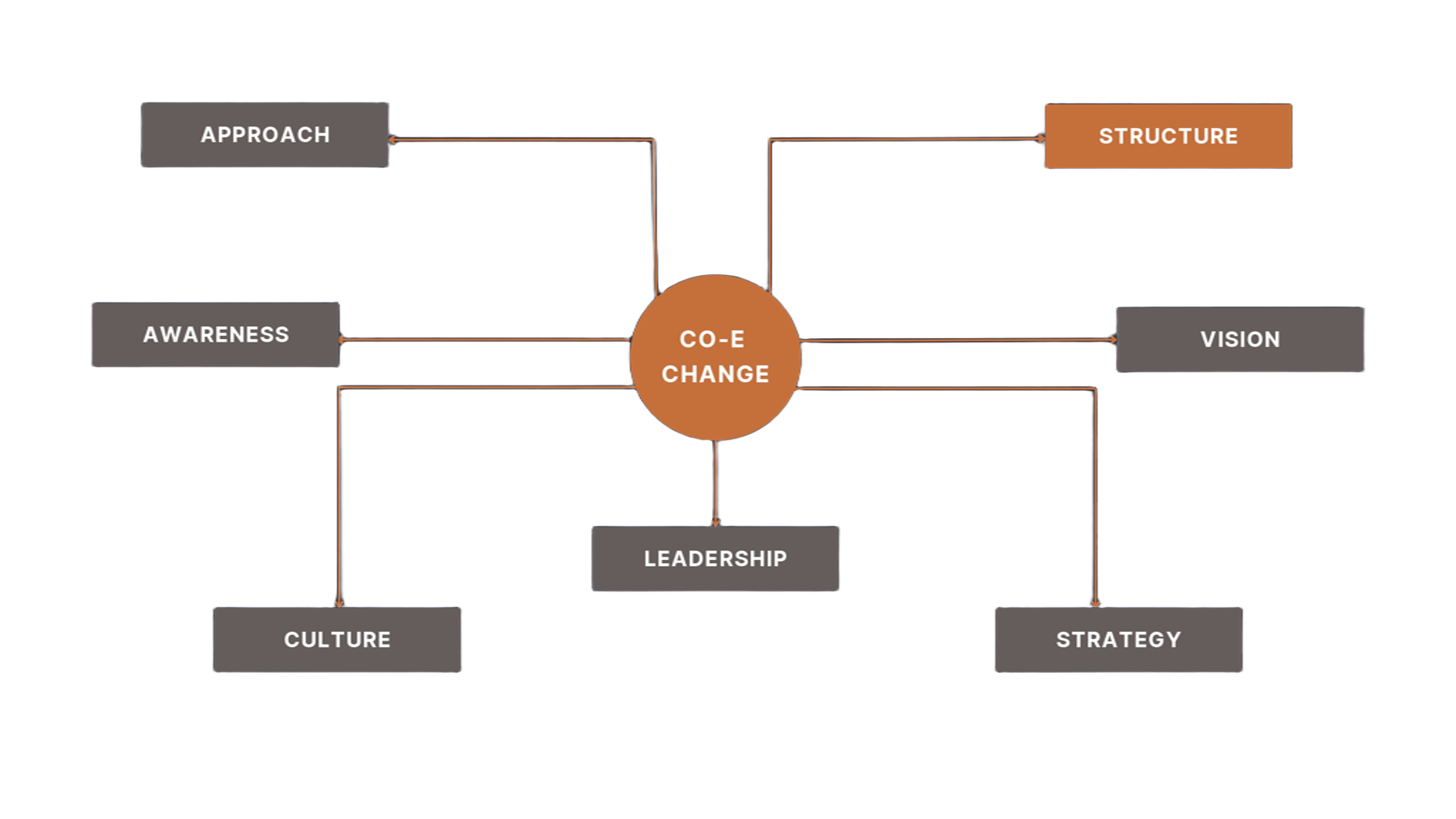
The CO-E Change Framework is a seven-phase organizational development framework designed to measure and strengthen communicative intelligence in professional contexts.
The framework combines emic perspectives from leaders, employees, and teams with etic organizational analysis. This enables CO-E to examine the relationship between organizational intentions, individual experiences, relational dynamics, execution, and measurable performance.
The phases
We clarify the external and internal structures surrounding the organization’s performance and the specific challenge being addressed.
Through the STRUCTURE Assessment and dialogue with management, we examine the organization’s strategic direction, expectations, leadership conditions, structural barriers, cultural context, and desired development.
Leaders complete LREL, which examines their perceived relational leadership impact through communication, relationships, and execution.
This phase creates a shared understanding of the challenge and establishes the organizational framework for the program.
We explore how employees understand their roles, responsibilities, relationships, and organizational environment.
Employees contribute their own perspectives through dialogue, reflection, and the EREL and EPRO Assessments. EREL examines relational skills, communication, expectations, and the transformation of understanding into action. EPRO examines motivational conditions, leadership communication, team dynamics, autonomy, and perceived ability to execute successfully.
This phase makes it possible to compare the organization’s intended direction with the reality experienced by employees.
We bring the team perspective into the process and examine how communication and relational dynamics influence collective execution.
Through TREL, team members reflect individually on team communication, collaboration, shared understanding, leadership influence, and the organizational structures affecting their work.
C-AGIL examines how relational and structural dynamics affect the organization’s ability to respond to a specific challenge.
This phase identifies strengths, weaknesses, and patterns affecting the team’s ability to translate strategy into coordinated action.
We analyze the interaction between management, leaders, employees, and teams.
The purpose is to identify how intentions and expectations move through the organization and how leadership communication is understood, interpreted, and transformed into behavior.
Participants begin the first executional phase by developing greater awareness of how they lead themselves, influence others, and operate within the team and organizational system.
The team begins to examine the shared patterns, assumptions, behaviors, and relational norms that shape everyday performance.
This phase makes visible how culture is formed through repeated communication and interaction, not only through formally stated values.
The organization can then identify which cultural patterns support its direction and which patterns must evolve to enable stronger collaboration and execution.
Individuals and teams reflect on the development that has taken place and on how their understanding of specific professional situations has changed.
Participants become more aware that communication, leadership, and relational behavior can be interpreted and approached in several ways.
This phase strengthens the ability to recognize one’s own impact, understand the perspectives of others, and make more conscious choices in professional contexts.
2nd measurement of LREL, EREL & EPRO.
The final phase moves development into sustained action.
Individuals and teams apply their new understanding through communication, collaboration, decision-making, and execution within the organization.
The purpose is to transform awareness into a more effective professional approach, enabling participants to act as more communicatively intelligent, relationally aware, and adaptable members of the organization.
The framework thereby connects organizational analysis with individual and collective development, creating a pathway from understanding to measurable action.
Baars, B. J., & Gage, N. M. (2010). Cognition, brain, and consciousness: Introduction to cognitive neuroscience (2nd ed.). Academic Press.
Bateson, G. (1972). Steps to an ecology of mind: Collected essays in anthropology, psychiatry, evolution, and epistemology. University of Chicago Press.
Bourdieu, P. (1990). The logic of practice. Stanford University Press.
Bourdieu, P. (2000). Pascalian meditations. Stanford University Press.
Burnes, B. (2004). Managing change: A strategic approach to organisational dynamics (4th ed.). Financial Times Prentice Hall.
Cummings, T. G., & Worley, C. G. (2014). Organization development and change (10th ed.). South-Western College Publishing.
Damasio, A. R. (2000). Descartes' error: Emotion, reason, and the human brain. G. P. Putnam's Sons.
Eleazu, O. (2020). The cult of service excellence: How to build a truly customer-centric culture. Practical Inspiration Publishing.
Elting, M., & Hammer, S. (2021). Ledelse, organisering og strategisering (3. udg.). Hans Reitzels Forlag.
Friedman, M. (2008). Price theory. Aldine Transaction.
Gergen, K. J. (1994). Realities and relationships: Soundings in social construction. Harvard University Press.
Gergen, K. J., & Gergen, M. M. (2005). Social construction: Entering the dialogue. Taos Institute Publications.
Hall, E. T. (1976). Beyond culture. Anchor Books.
Hasselager, A., Jørgensen, B. A., & Larsson, H. (2005). Psykodynamisk organisationspsykologi. Hans Reitzels Forlag.
Hofstede, G., Hofstede, G. J., & Minkov, M. (2010). Cultures and organizations: Software of the mind (3rd ed.). McGraw-Hill Professional.
Holman, P., Devane, T., & Cady, S. (Eds.). (2007). The change handbook: The definitive resource on today's best methods for engaging whole systems (2nd ed.). Berrett-Koehler Publishers.
Jakobsen, M. (2015). Navigating a global corporate culture: On the notion of organizational culture in a multinational corporation. International Journal of Cross Cultural Management.
Keith, K. D. (Ed.). (2019). Cross-cultural psychology: Contemporary themes and perspectives (2nd ed.). Wiley-Blackwell.
Kernberg, O. F. (1998). Ideology, conflict, and leadership in groups and organizations. Yale University Press.
Marquardt, M. J., & Schwandt, D. R. (1999). Organizational learning: From theory to practice. CRC Press.
Maturana, H. R., & Varela, F. J. (1992). The tree of knowledge: The biological roots of human understanding (Rev. ed.). Shambhala Publications.
Mello, J. A. (2019). Strategic human resource management (5th ed.). Cengage Learning.
Metzinger, T. (2009). The ego tunnel: The science of the mind and the myth of the self. Basic Books.
Meyer, E. (2014). The culture map: Breaking through the invisible boundaries of global business. PublicAffairs.
Molly-Søholm, T. (2012). Teambaserede organisationer i praksis: Ledelse og udvikling af team. Hans Reitzels Forlag.
Møllerskov, H. D. (2020). Intercultural and global competencies (2nd ed.). Hans Reitzels Forlag.
Nisbett, R. E., Peng, K., Choi, I., & Norenzayan, A. (2001). Culture and systems of thought: Holistic versus analytic cognition. Psychological Review, 108(2), 291–310.
Osland, J. S., & Bird, A. (2000). Beyond sophisticated stereotyping: Cultural sensemaking in context. Academy of Management Executive.
Riber, J. (2010). Relationskompetence. Hans Reitzels Forlag.
Schwandt, D. R. (2005). Organizational learning: From world-class theories to global best practices. Information Age Publishing.
Strickland, J. (2011). Simulation conceptual modeling. Lulu Press.
Suchman, M. C. (1995). Managing legitimacy: Strategic and institutional approaches. Academy of Management Review, 20(3), 571–610.
Thornton, P. H., Ocasio, W., & Lounsbury, M. (2012). The institutional logics perspective: A new approach to culture, structure, and process. Oxford University Press.
Tourangeau, R., Rips, L. J., & Rasinski, K. (2000). The psychology of survey response. Cambridge University Press.
Visholm, S. (2004). Organisationspsykologi og psykodynamisk systemteori. In T. Heinskou & S. Visholm (Eds.), Psykodynamisk organisationspsykologi (pp. 23–48). Hans Reitzels Forlag.
White, M. (2007). Narrative practice: Continuing the conversations. W. W. Norton & Company.
The assessments
The CO-E Assessments aim to measure communicative intelligence across organizations by examining multiple organizational perspectives and integrating industry-specific insights.
Each completed assessment provides unique insights into the perceived impact of communication and relationships across the organization.
To define the organizational challenge and establish the strategic, structural, and relational foundation for the development process.
Management and organizational perspective.
To measure the leader's communicative intelligence and relational impact within the organizational framework.
Leader.
To measure the employee's communicative intelligence and relational contribution within the organizational framework.
Employee.
To measure the motivational conditions influencing engagement, performance, and execution.
Employee.
To measure communicative intelligence, relational dynamics, and collaborative performance within teams.
Individual team member and collective team.
To measure the organization's relational agility when responding to a specific organizational challenge.
Management, leader and employee.